The phrase “textile waste UK” covers more than unwanted clothes. It includes old uniforms, household linens, commercial offcuts and losses along supply chains. Much of this is invisible once it leaves our hands.
WRAP warns that the current “take, make, use and dispose” model uses resources unsustainably. Its circular economy vision aims to cut water use, reduce greenhouse gas emissions and lower the environmental footprint by changing how we buy, wear and re-use items.
This report sets out what readers will learn: the scale and causes of the problem, the real impact across making, wearing and disposal, and practical solutions tailored to British realities. We explain why recycling outcomes depend on fibre type and contamination, and why the issue often stays hidden after disposal.
Key Takeaways
- “Textile waste” goes beyond clothes to include household and business streams.
- WRAP promotes a circular approach to reduce water use and emissions.
- Recycling success relies on fibre mix and low contamination.
- The full footprint spans production, use and end‑of‑life routes.
- Stakeholders — brands, employers and authorities — must act together.
Executive summary: why textile waste matters now
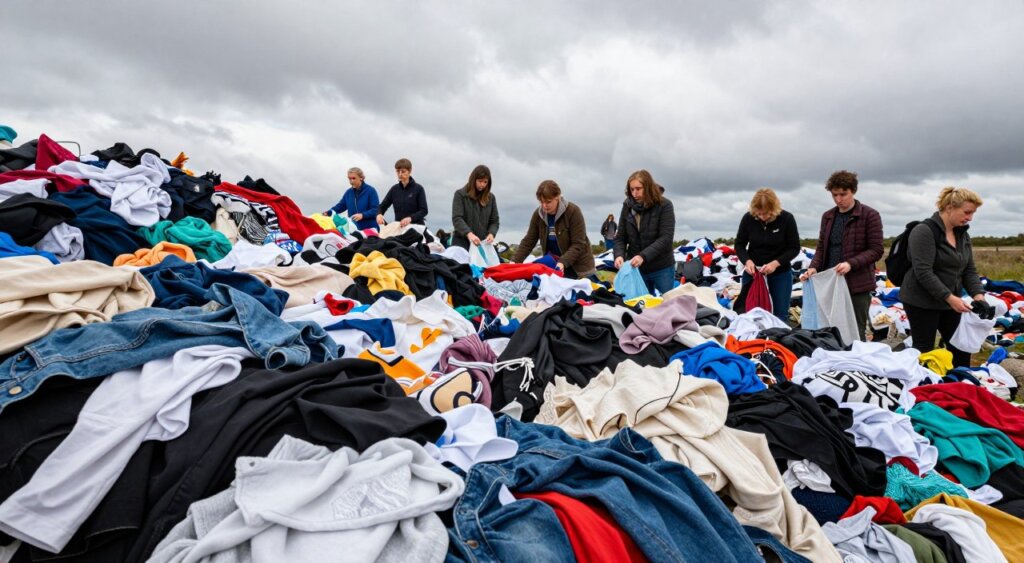
Rising consumption in fashion has turned fast turnover into a major resource and disposal challenge.
Globally, around 92 million tonnes of discarded garments and related materials flow into end‑of‑life routes each year. The sector accounts for roughly 8–10% of global carbon emissions, and a single cotton shirt can need about 2,700 litres of water to produce.
The scale: national versus global
UK disposal links directly to global supply chains. Local clearance, exports and sorting affect resource use abroad and at home. That connection makes the problem immediate for British businesses and consumers.
Key environmental and economic takeaways
Decision‑makers should focus where impacts concentrate: fibre mixes that resist recycling, high‑volume clothing streams and commercial collections. Preventing disposal and extending life give the fastest returns on water, carbon and cost.
| Metric | Global figure | UK priority action |
|---|---|---|
| Annual discarded tonnage | ~92 million tonnes | Reduce consumption; improve reuse networks |
| Sector carbon share | 8–10% of global emissions | Board‑level carbon targets; supply chain audits |
| Water per cotton shirt | ~2,700 litres | Promote low‑water fibres and longer use |
Textile waste UK: the current picture in tonnes, trends and sources
Counting what goes to landfill gives a clear picture of scale and where action is needed. The UK sends about 1,200,000 tonnes of textiles to landfill every year, of which roughly 350,000 tonnes are clothing items.
How much ends up in landfill and what it includes
“Textiles” here covers clothes, bedlinen, towels, curtains and some commercial offcuts. These streams include household items, discarded retail stock and scrap from manufacturing.
Household clothing waste and what the average person throws away
On average each person discards 3.1kg of textiles per year, with 1.7kg of that heading to landfill. People commonly bin items due to damage, poor fit, changing trends or low durability.
Commercial textile waste from uniforms, workwear and brand collections
Businesses contribute via uniforms, workwear and unsold collections. Security or brand protection can force secure destruction rather than reuse or donation.
Where waste is generated across the textile industry lifecycle
Losses occur at design, during production, from overstock in retail, through everyday use at home and finally at disposal. Fibre type, item condition and contamination strongly affect sorting and recycling outcomes.
| Stream | Approx. annual tonnes | Notes |
|---|---|---|
| Landfilled textiles | 1,200,000 tonnes | Includes clothing and household items |
| Clothing to landfill | 350,000 tonnes | Average 1.7kg per person to landfill |
| Household discard | — | 3.1kg per person discarded each year |
Understanding these sources matters because collection systems and recycling technology decide what is economically viable next. The link between landfill volumes and prevention will be explored in the following sections.
Where textile waste comes from across the textile industry
Upstream decisions in design and production now determine whether an item becomes a lasting possession or an early discard. That choice shapes how garments are made, marketed and handled at end of life.
Fast fashion and shortened garment life
Fast fashion drives rapid trend cycles. Many clothes are worn fewer than ten times before being discarded, which raises the volume of waste and shrinks useful life.
Low prices and low repairability mean consumers replace items instead of fixing them. This behaviour keeps buying high and lifetime low.
Overproduction, off‑cuts and defective items in production
Brands often produce far more stock than they can sell. Unsold items, deadstock and brand‑led destruction add to streams before any item reaches a customer.
On the factory floor, cutting rooms create off‑cuts, sampling produces short runs and defects fail quality checks. These production losses are a major, visible source of items that never enter use.
Materials and fibres that dominate today’s clothes
Most modern garments mix synthetics like polyester with natural fibres. Blends make recycling harder and often prevent closed‑loop recovery.
Globally, about 87% of fibre input for clothing is landfilled or incinerated, and under 1% becomes new garments through recycling. Fibre choice therefore locks in end‑of‑life outcomes and raises costs for local authorities, collectors and recyclers.
| Source | Main driver | End‑of‑life implication |
|---|---|---|
| Fast fashion | Rapid trends; low prices | Short life; higher discard rates |
| Overproduction & deadstock | Sales forecasting; brand policies | Unsold stock; secure destruction |
| Production losses | Off‑cuts, samples, defects | Material waste; limited recycling |
The environmental footprint: water, pollution and greenhouse gas emissions
Every garment carries a hidden tally of water, chemicals and carbon from field to landfill.
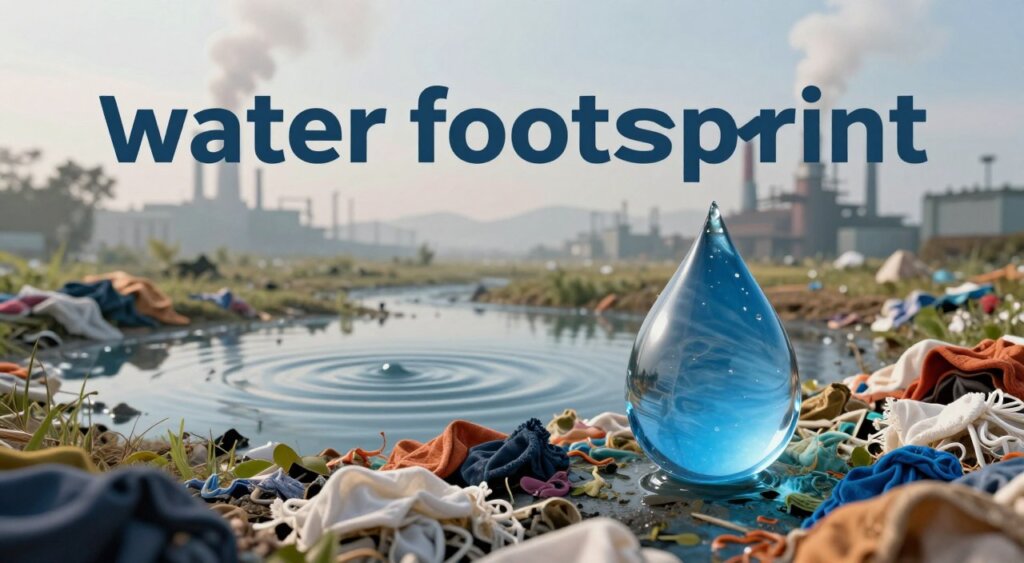
Water intensity and the cotton shirt example
One cotton shirt can need about 2,700 litres water in its life‑cycle. Extending how long a shirt is worn cuts that hidden demand sharply.
The wider industry uses roughly 79 billion cubic metres of water each year, so better stewardship across supply chains matters.
Carbon and lifecycle emissions
Fashion emits across raw materials, manufacture, transport, washing and end‑of‑life. Raw fibre and production often dominate a product’s carbon footprint.
UK organisations can reduce impact by choosing durable designs, favouring lower‑impact fibres and promoting reuse.
Microplastics, dyeing and disposal
About 35% of primary microplastic ocean pollution links to synthetic fibres such as polyester. Fibres shed during wear and washing; filters and material choice help.
Dyeing is a major polluter of water when effluent is unmanaged. Better chemistry and transparency cut local pollution and health risks.
| Issue | Typical source | Practical action |
|---|---|---|
| High water use | Cotton production (2,700 litres per shirt) | Extend use; select low‑water fibres |
| Microplastic pollution | Polyester shedding in wash | Install filters; prefer natural fibres |
| Emissions at disposal | Landfill & incineration | Prioritise prevention; optimise contracts |
What really happens to clothes after disposal in the UK
After you drop a bag at a clothing bank, the next steps are sorting, grading and a series of possible end points that most people never see.
Charity shops, clothing banks and sorting routes
Charity shops and collection banks are the usual first stop. Staff and automated lines check items for stains, damage and odours.
Anything unsuitable for resale is set aside for recycling collections or lower‑grade processing. That sorting decides the rest of the journey.
Reuse, export, rag recycling and Energy from Waste
Higher‑quality garments are sold in shops or passed to resale markets at home. Many mid‑grade items are exported to overseas markets.
Lower‑grade textiles enter rag recycling and become underlay, insulation or cleaning cloths. When recycling is not viable, Energy from Waste incineration is used.
| Route | Typical outcome | Notes |
|---|---|---|
| Reuse | Shop sale or charity collection | Best for keeping items in life and cutting emissions |
| Export | Overseas resale | Market demand and quality determine export volumes |
| Rag recycling | Carpet underlay, insulation, rags | Not closed‑loop for clothing; useful secondary products |
Secure shredding for uniforms and branded garments
Uniforms and branded items with logos are often securely shredded. This prevents impersonation and counterfeiting and meets brand protection rules.
Secure destruction adds cost, but it reduces risk for employers and protects customers from fraud.
Across these routes, emissions arise from transport, export logistics and energy recovery. The biggest impact cuts come from extending use and improving sorting so more items stay in circulation.
Why textile recycling is hard: fibres, blends and contamination
Different fibres need distinct sorting and treatment, so a mixed bag is tricky to process.
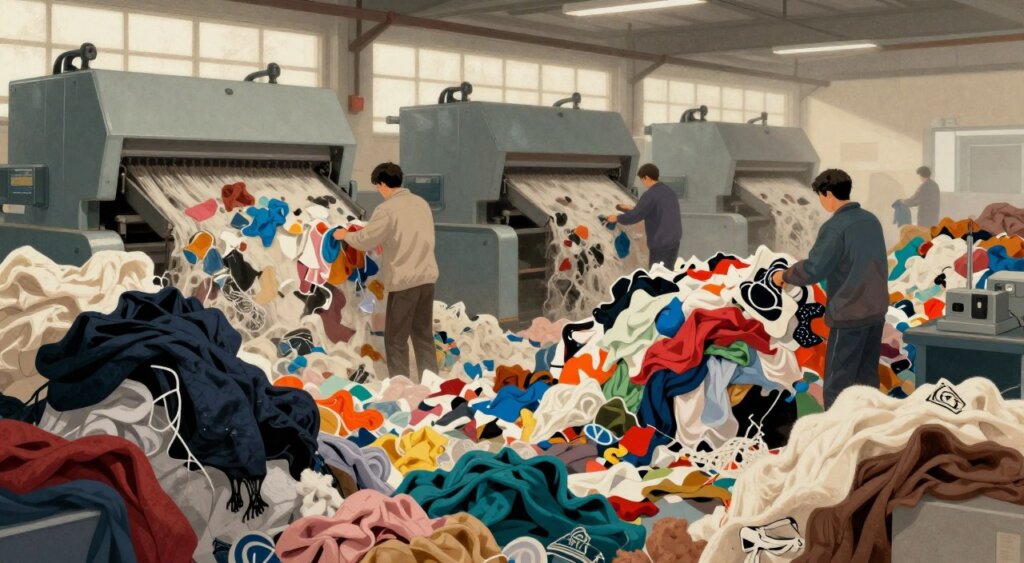
Cotton and polyester — two very different routes
Cotton is usually shredded and the fibres pulled apart, then carded and respun. That mechanical route works best with clean, mono cotton fabric.
Polyester is shredded, melted and re-extruded into new yarn. Heat and melt points make this a thermal process, not mechanical.
Why blends break the system
Blends such as poly-cotton combine polymers and cellulose. Their chemistry and different melting points stop both mechanical and melt-based methods working well.
Separating fibres is costly and slow. At scale, the economics rarely add up for collectors or recyclers.
Contamination and embellishments
Oil, mould, chemical finishes and heavy dyes make cleaning expensive and risky. They reduce quality and can force incineration or energy recovery.
Sequins, beads, coatings and linings need manual removal. That labour pushes many items out of the recycling stream.
- Expect realistic claims: only mono-fibre items are usually fully re-made into new garments.
- Design simpler fabric constructions to improve recycling outcomes.
Solutions and opportunities: moving the UK towards a circular economy for textiles
A clear set of practical steps can translate circular goals into everyday choices for brands and households.
WRAP’s circular economy vision made practical
WRAP asks organisations to prevent waste, keep items in use and design so products have a next life. Simple targets—fewer disposals, longer wear and verified recycling chains—drive measurable cuts in greenhouse gas emissions and water use.
Design for recyclability in procurement language
Use mono-material specs, limit blends and standardise trims. Ask suppliers for product sheets that list fibre content, detachable labels and simple fastenings. These procurement rules make sorting and recycling faster and cheaper.
Choose low‑impact fibres and next‑generation options
Linen can need as little as 6.4 litres for a shirt versus ~2,700 litres for a cotton example, making cellulose alternatives a clear resource win. Hemp and other cellulose fibres offer durability, comfort and easier biodegradability for workwear and casual clothes.
Plant-based leathers (Piñatex, VEGEA, Desserto, AppleSkin™, Mylo) and fabrics from seaweed or citrus are emerging options. Check availability, certifications and lifecycle claims before scaling use.
Scaling infrastructure and immediate actions
ACT UK’s £4m programme shows how better collection, consistent sorting and scalable preparation can raise recycling for non-rewearable items. To act now, audit flows, set take-back schemes and contract transparent recyclers.
| Action | What to ask for | Impact |
|---|---|---|
| Procurement spec | Mono-materials; detachable trims | Better recyclability; lower processing cost |
| Material switch | Linen, hemp, certified plant leathers | Lower water use; reduced carbon |
| Collection & sorting | Take-back; standardised labelling | More reuse; less landfill |
Do now checklist: buy less and better, repair to extend life, set up take-back, audit your textile streams, and choose transparent recycling routes. These steps cut emissions, save resources and improve compliance and reputation.
Conclusion
This conclusion links national figures to everyday choices that cut environmental harm. The UK sends about 1,200,000 tonnes to landfill every year, while global totals near 92 million tonnes. Those numbers matter for landfill capacity, emissions and local pollution.
Garbage arises at design, production, purchase and disposal. After donation or collection, many items face sorting, export, shredding or incineration. Recycling is not guaranteed for blended or contaminated clothing, so preventing discard is vital.
Practical levers now are clear: prevent disposal, extend garment life, improve collection and sorting, and choose smarter materials. Scaling circular practices reduces impact at home and across the industry while protecting the environment.
Use this report as a decision guide—when you set procurement rules, manage uniforms or change how you buy and care for clothes.





 call now